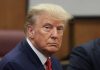
President Bola Ahmed Tinubu has emerged as the presidential candidate of the All Progressives Congress (APC) for the 2027 general election after polling 10,999,162 votes in the party’s nationwide presidential primaries.
Tinubu secured a landslide victory over his challenger, Stanley Osifo, who garnered 16,503 votes following the collation of results from across the 36 states, the Federal Capital Territory, 774 local government areas and 8,809 wards nationwide.
The APC chairman, Professor Nentawe Yilwatda, presented the President with the party’s certificate of return and symbolic flag during the event held at the International Conference Centre, Abuja, attended by governors, National Assembly members, ministers, party stalwarts and members of the APC National Working Committee.
Speaking after accepting the nomination, Tinubu pledged to consolidate his administration’s economic reforms, strengthen national security and deepen democratic governance if re-elected for a second term.
“In accepting this nomination, I renew my commitment to serve our nation with even greater determination,” the President said.
“With another four years of disciplined focus and national cooperation, we will firmly place Nigeria on an irreversible path of economic expansion, industrialisation, energy security, infrastructure development, food sufficiency, and democratic consolidation,” he added.
Chairman of the APC Presidential Election Committee, Senator Anyim Pius Anyim, announced the final results and described the exercise as transparent and credible.
According to him, 12,643,316 party members were registered for the exercise, while 11,069,746 members were accredited and 11,015,665 votes were cast during the primaries.
Anyim stated that the process complied fully with the Electoral Act, INEC guidelines and the APC constitution, noting that agents of both aspirants were allowed to challenge results and seek redress where necessary.
The President used the occasion to defend his administration’s economic policies and reforms, insisting that difficult decisions taken since 2023 were already yielding positive outcomes.
“Our economy has undergone significant structural reform, supported by new tax laws and fiscal policies that have boosted revenue collection for the federation,” Tinubu stated.
He highlighted the establishment of the Nigerian Education Loan Fund, saying over N282 billion had been disbursed to more than 1.5 million beneficiaries.
“We promised to remove the financial barriers to higher education for our youth. Today, we have established the Nigerian Education Loan Fund, with over N282 billion disbursed and over 1.5 million beneficiaries,” he said.
Tinubu also defended the removal of fuel subsidy and exchange rate reforms, maintaining that the policies were necessary to stabilise the economy.
“We moved away from wasteful fuel subsidies, unstable exchange rates, and weak infrastructure. Today, we are witnessing a turnaround: the naira is strengthening, foreign reserves are rising, and our economic outlook is positive despite the inflationary disruption caused by the war in Iran and the geopolitical crisis in the Middle East,” the President said.
On infrastructure, the President said his administration was investing heavily in roads, power, airports, seaports and digital connectivity to drive inclusive growth and economic competitiveness.
“We are building concrete, durable roads and superhighways along the coast and on the Sokoto-Badagry route that will last for over 100 years,” he stated.
Tinubu also acknowledged ongoing security challenges across parts of the country, assuring Nigerians that his administration remained committed to restoring peace and stability.
“I assure you that I take seriously the responsibility to safeguard the lives and property of every Nigerian. We will not rest until we restore peace and stability to every corner of our country,” he said.
The President further extended an olive branch to opposition parties and critics, urging collaboration in national development despite political differences.
“Democracy is sustained not by uniformity, but by diversity, by a shared belief in the nation and the blending of ideas,” Tinubu added.