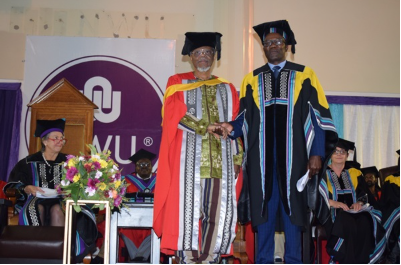
Nigeria has renewed its presence in global academia with another major recognition for Toyin Falola, one of the world’s most influential African scholars. In May 2025, North-West University (NWU) in South Africa awarded Falola an honorary doctorate in acknowledgement of his decades-long contributions to history, culture and African studies.
The honorary degree, conferred during the NWU’s graduation ceremony at its Mahikeng Campus, reflects Falola’s significant global impact as a historian and public intellectual. Known for his extensive scholarship on African history, colonialism, politics and diaspora studies, Falola’s work has shaped academic conversations across continents and raised international awareness of African perspectives within global historical discourse.
Professor Falola serves as the Jacob and Frances Sanger Mossiker Chair in the Humanities at the University of Texas at Austin, where he has taught since the early 1990s. Over the course of his career, he has authored and edited more than 200 books and numerous academic papers, earning him recognition as one of the most cited African scholars of his generation.
In his acceptance speech at NWU, Falola emphasised the value of knowledge that crosses cultural and geographical boundaries, pointing to the role universities play in nurturing socially responsible and globally engaged graduates. The institution’s recognition of his work underscores the importance of scholarship rooted in African perspectives — a field Falola has consistently championed throughout his career.
This latest honorary doctorate adds to a long list of accolades from universities around the world, including similar recognitions from the University of the Free State (UFS) and other international institutions. These honours reflect the esteem with which global academic communities regard Falola’s contributions to the humanities.
Falola’s influence extends beyond the academy. He has advised organisations such as UNESCO, the African Union and ECOWAS on matters ranging from peacebuilding to cultural policy. His work is widely recognised not only for its depth of research but also for its practical relevance to understanding Africa’s place in world history.
For Nigeria, Professor Toyin Falola’s international recognition contributes to the country’s reputation for producing scholars who shape global thought and education. As African universities strive to produce world-class scholarship that engages with global audiences, Falola’s achievements stand as an example of how Nigerian intellectuals continue to make lasting contributions far beyond national borders.